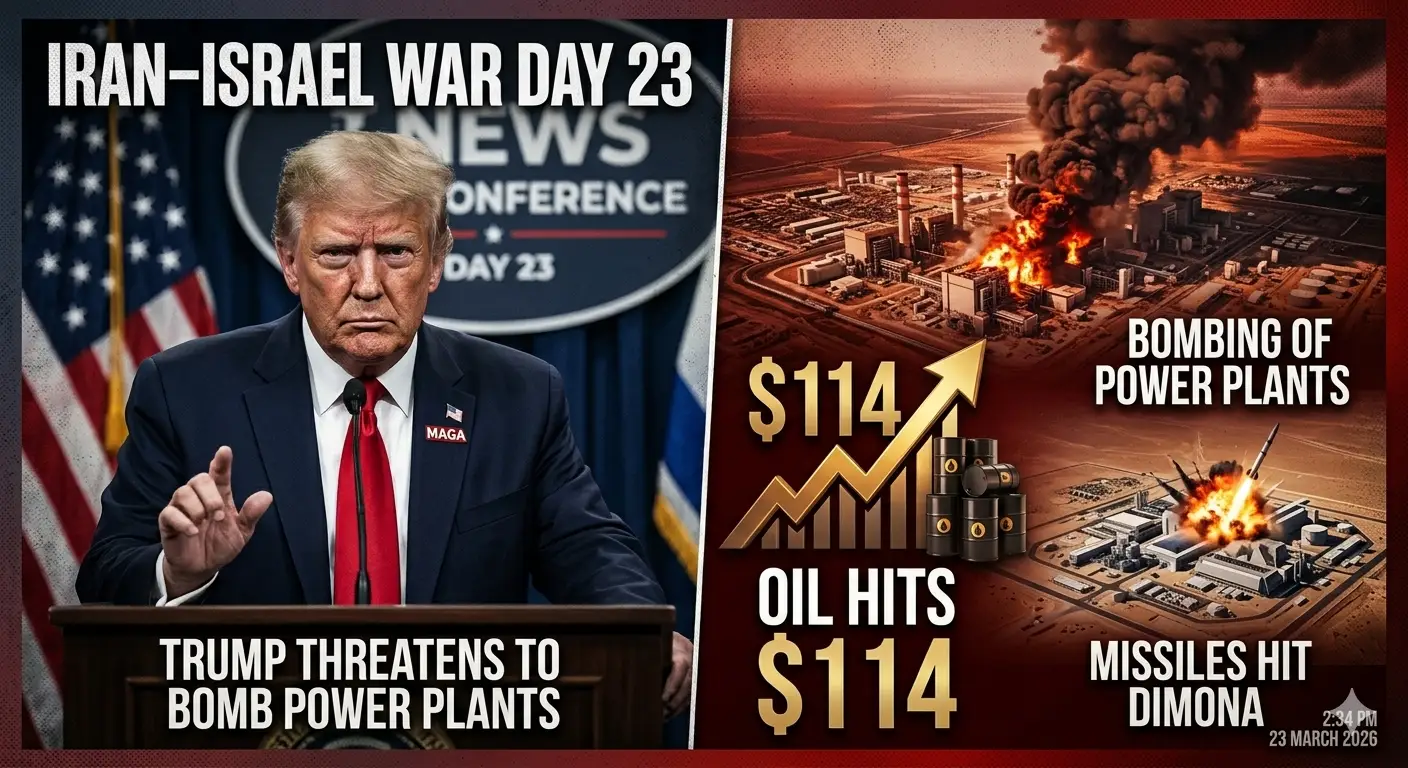
U.S. President Donald Trump has given Iran 48 hours to reopen the Strait of Hormuz or face strikes on power plants, as Iranian missiles injure 180 in southern Israel and oil prices surge to a four-year high.
WASHINGTON / TEL AVIV, March 23, 2026 — The Iran–Israel war entered its 23rd day on Monday with a sharp new escalation: U.S. President Donald Trump threatened to “hit and obliterate” Iran’s power plants if the Strait of Hormuz is not fully reopened by Monday evening. Iran responded by declaring it was ready to close the waterway indefinitely and warned that critical infrastructure across the Middle East could be “irreversibly destroyed.”
Missiles Strike Dimona and Arad
The latest crisis was triggered over the weekend, when Iranian ballistic missiles struck the southern Israeli cities of Dimona — home to Israel’s main nuclear research facility — and Arad. Israel’s Health Ministry confirmed at least 180 people were wounded, including 10 seriously. Israeli air defense systems failed to intercept two of the missiles, with warheads weighing hundreds of kilograms causing buildings to collapse and fires to break out.
Israeli Prime Minister Benjamin Netanyahu visited Arad and condemned Iran’s targeting of civilians, vowing to continue striking Iran. The strikes were framed by Iranian state television as retaliation for an earlier U.S.–Israeli attack on the Natanz nuclear enrichment complex, though no radioactive leakage was reported.
Oil at $114 as Hormuz Tensions Peak
Energy markets reacted sharply to Trump’s ultimatum. Brent crude climbed to approximately $114.09 a barrel on Sunday, while U.S. crude rose above $100 — the first time since 2022. Goldman Sachs warned in a Friday note that elevated oil prices could persist through 2027. The International Energy Agency has described the disruption to global energy markets as worse than the 1973 and 1979 oil shocks combined.
22 Nations Pledge to Protect Shipping
The United Arab Emirates and Australia joined a 22-nation statement pledging to help secure safe navigation of the Strait of Hormuz, though the specifics of any enforcement mission have not been announced. The UK Maritime Trade Operations agency has maintained a “critical” threat level across the Gulf and Strait of Hormuz since March 1, noting 21 confirmed attacks on commercial vessels.
Broader Regional Fallout
Hezbollah continued exchanging fire with Israel along Lebanon’s southern border, with Israel striking a critical bridge over the Litani River on Sunday. In Iraq, U.S.–Israeli strikes on Iran-backed militia groups have killed at least 61 people. Gulf Arab states including Saudi Arabia, Qatar, and Kuwait have reported Iranian drone and missile attacks on energy infrastructure following Israel’s strike on Iran’s South Pars gasfield.
The United Nations warned last week that 3 million Iranians have been displaced since the conflict began on February 28. UN human rights experts have flagged several strikes as potential war crimes. More than 1,500 civilians have been killed in Iran, according to Iranian state media.
Ceasefire Prospects Remain Distant
Trump has claimed “productive conversations” are taking place with Iran, but Tehran has publicly denied any negotiations are underway. The U.S. has said it is considering “winding down” the conflict while ruling out a formal ceasefire. Congressional Republicans have raised questions about authorizing the war, with Senator Lisa Murkowski indicating she may push for a war authorization vote if U.S. ground troops are deployed.
The 48-hour ultimatum deadline arrives Monday evening. The situation remains highly volatile.
— Updated March 23, 2026 | Keywords: Iran Israel war 2026, Strait of Hormuz, Dimona missile strike, Trump Iran ultimatum, Middle East oil prices